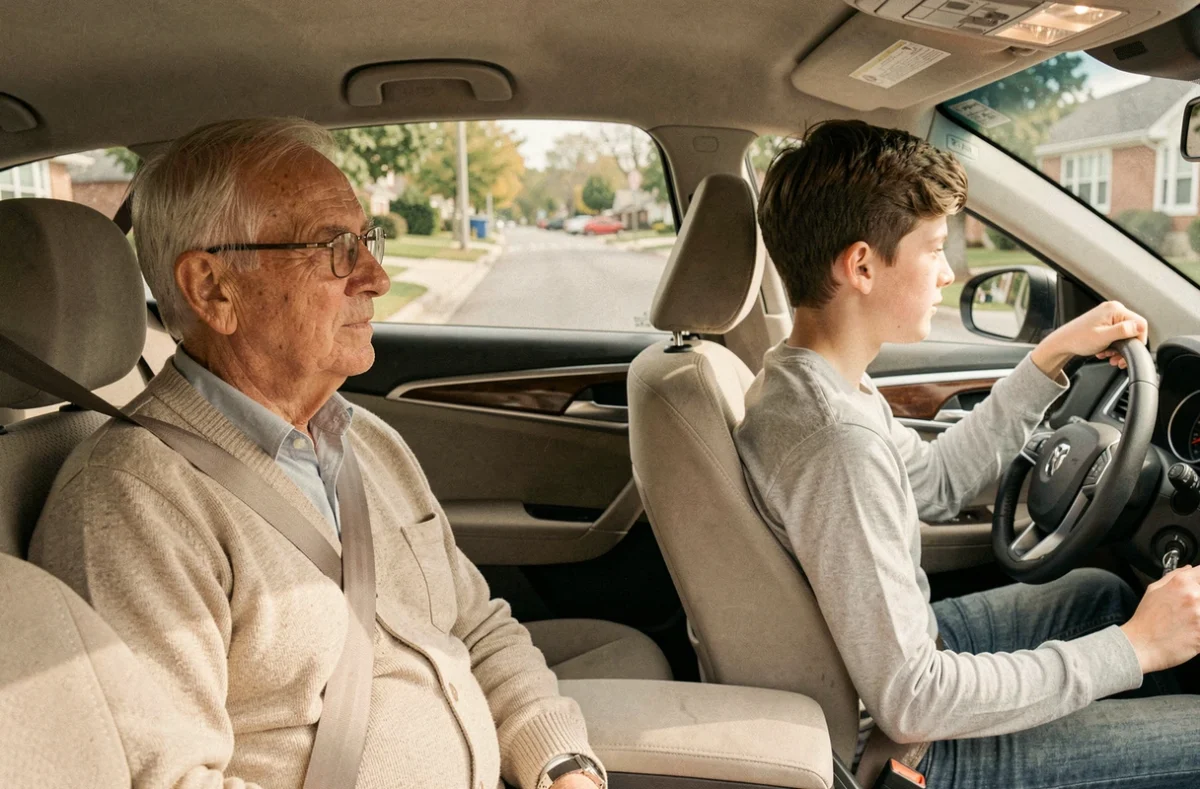
In France, the law does not require the accompanying driver in accompanied driving to be a direct relative of the learner. A grandparent can therefore supervise a young driver as long as they meet the regulatory requirements that apply to all accompanying drivers. The main challenge is not legality but the practical organization of this intergenerational learning experience: vehicle insurance, attendance at training sessions, and coordination with the driving school.
Legal requirements for accompanying drivers: what the regulations say
The regulatory framework for early driver training (AAC) sets the same criteria regardless of the accompanying driver’s relationship to the learner. The table below summarizes the requirements, whether the accompanying driver is a parent or a grandparent.
| Criterion | Regulatory requirement | What grandparents should check |
|---|---|---|
| Valid Category B driving licence | Held for at least 5 consecutive years | Check that no suspension or revocation has interrupted its validity |
| Family relationship | No relationship required | A grandparent, uncle, or family friend is eligible |
| Insurer’s approval | Obtained before the driving phase begins | Applies to the vehicle being used, not just the grandparent’s policy |
| Training sessions | At least one accompanying driver must attend each session | Plan to be available throughout the training period |
| Minimum distance (AAC) | 3,000 km over at least 1 year | If the grandparent is not the only accompanying driver, the kilometres count together |
Taking accompanied driving with grandparents involves the same administrative requirements as having any other accompanying driver. The difference lies in the arrangements, not the law.
One important point: several accompanying drivers can be designated at the same time. Parents and grandparents can then share the driving, provided each person is individually registered with the driving school and insurer.
Vehicle insurance and accompanied driving: checks not to overlook
The insurer’s approval applies to the vehicle, not to the accompanying driver. This distinction matters when a grandparent uses their own car to supervise the learner.
If the young driver usually drives the family car insured by their parents, the coverage extension applies to that specific vehicle. Changing cars requires a new declaration to the relevant insurer. A grandparent offering their own car must therefore contact their insurer to obtain an extension of coverage, even if the young driver is already listed on their parents’ policy.
Borrowing a vehicle from a third party adds another layer of complexity. The grandparent’s usual insurance is not enough if the vehicle belongs to someone else. The vehicle’s owner must obtain their insurer’s approval to cover the training period.
Insurance steps to take
- Contact the insurer of the vehicle being used to obtain a coverage extension specifically for accompanied driving, providing the learner’s and accompanying driver’s details
- Check coverage if using multiple vehicles: each insurance policy must have its own extension
- Keep the insurer’s certificate in the vehicle on every trip, along with the learner’s logbook
Organizing training with a grandparent: availability and coordination with the driving school
Having held a licence for decades does not automatically make a grandparent a good driving instructor. Experience behind the wheel and the ability to teach good habits are two distinct skills.
The driving school issues a certificate of completion for the initial training phase, marking the start of accompanied driving. From that point on, the accompanying driver must attend the training sessions organized by the driving school. These sessions are not optional: they provide an opportunity to review the young driver’s progress, adjust goals, and correct any bad habits.
For a grandparent, this means being regularly available for at least a year. Training sessions are held periodically but are mandatory, and at least one accompanying driver must attend.
Gradual routes and teaching good habits
A grandparent accompanying a young driver may tend to pass on their own driving habits. Some of these may differ from what is taught at the driving school. Official teaching methods have evolved when it comes to safe following distances, checking mirrors before every change of direction, and positioning on roundabouts.
Coordinating with the driving instructor helps avoid contradictions between what the learner is taught during lessons and what they practise during accompanied driving. A few practical guidelines can help structure their progress:
- Start with short trips in quiet areas, then gradually increase the distance and vary the settings (motorways, city centres, mountain roads)
- Practise different types of driving: parking, merging onto a fast road, driving at night or in the rain, to cover the range of situations encountered in the driving test
- Don’t hesitate to let the young driver navigate routes the grandparent does not know, to practise reading road signs and making independent decisions
AAC and supervised driving: two schemes not to confuse
Early driver training (AAC) is available to young people from the age of 15, with an accompanied driving phase of 3,000 km over at least one year. Since January 1, 2024, learners can obtain their licence at 17 and are then allowed to drive alone immediately.
Supervised driving is for learner drivers aged 18 and over. It does not require the same minimum distance or minimum duration as AAC. A grandparent who wants to accompany a learner should first identify which scheme they are following, as the requirements differ.
Drivers trained through AAC commit significantly fewer traffic offences than those who complete standard training. Their probationary period is reduced to 2 years instead of 3, reflecting the scheme’s statistical results. A grandparent who is available and well coordinated with the driving school can contribute to the quality of this training, provided they do not confuse personal experience with teaching methods.