
When you roll out a poster of the French dynasties in a classroom or a living room, you come across a beautiful continuous line of portraits, from the Merovingians to the Bourbons. Everything seems clear, almost obvious. The family tree of the kings of France gives the impression of a fluid succession, father to son, century after century. The dynastic reality is far more chaotic.
What the family trees of the kings of France do not show
Most of the visual representations available online, whether decorative posters or encyclopedic diagrams, work through simplification. The main branch is selected, a vertical line is drawn, and we move on to the next. The junior branches, the excluded claimants, the contested regencies disappear from the frame.
Take the transition from the Carolingians to the Capetians. Hugh Capet ascends to the throne while Carolingian descendants still exist. This dynastic break is erased by most trees, which link the two families as if one naturally descended from the other. We lose the political dimension of this transition, which is more a matter of noble force than of biological inheritance.
The same problem arises with the Valois. When the direct branch of the Capetians dies out, the crown passes to a collateral branch. The famous Salic law, invoked to exclude women and their descendants, is not a legal text fixed since the origins. It has been reinterpreted over the course of succession crises to justify already made political choices. To discover the family tree of the kings of France in detail, one must accept that each branch hides a conflict.

Salic law and contested lineages: the knots of the French dynastic tree
It is often believed that the French royal succession followed a clear rule. In practice, the Salic law was formulated retrospectively, consolidated over the centuries to respond to concrete situations. The Hundred Years’ War is the most spectacular example: Edward III of England claimed the crown of France through his mother, daughter of Philip IV. The refusal of this claim structured the French succession doctrine for the following centuries.
This is not a scholarly detail. Henry II of England, long before this crisis, was already dynastically connected to the French lines through his control of vast continental territories. The family trees of the two kingdoms intertwine to such an extent that sometimes two overlapping diagrams are needed to understand who claims what.
Junior branches resurfacing
The Bourbons themselves are just a junior branch of the Capetians, separated from the direct line since the 13th century. When Henry IV ascends to the throne, one must go back more than two hundred years to find the common ancestor with the last Valois. A simplified tree masks this considerable genealogical distance.
The consequences extend well beyond the Ancien Régime. Capetian branches find themselves linked to other European monarchies, further fueling symbolic claims.
- The Bourbon-Spain branch descends from Louis XIV and still reigns in Spain, creating a double dynastic connection between Paris and Madrid.
- The Orleans branch, descended from a brother of Louis XIV, produced a king (Louis-Philippe) and remains active in the French legitimist debate.
- Some junior branches have died out without male descendants, but their marital alliances have spread Capetian blood into almost all the ruling families of Europe.
The French royal family tree, a still-living political object
One might think that this subject remains confined to history textbooks. Social media shows otherwise. Content published on Facebook or Instagram explicitly designates a Bourbon claimant as the “true king of France.” Royal genealogy remains a terrain of identity claims in certain legitimist or Orleanist circles.
This phenomenon partly explains the popularity of posters and visual materials. The public demand leans more towards decorative representations than critical analyses. One buys a poster to display a reassuring continuity, not to expose the gray areas of royal lineage.
What is missing in commercial versions
The trees sold online almost systematically omit several elements that would condition their reliability:
- Female regencies, where real power was exercised by a queen mother without this appearing in the official lineage.
- Legitimized royal bastards, like those of Louis XIV, who nearly altered the order of succession.
- Debates of accuracy between competing versions, each dynastic current producing its own tree with different branches.
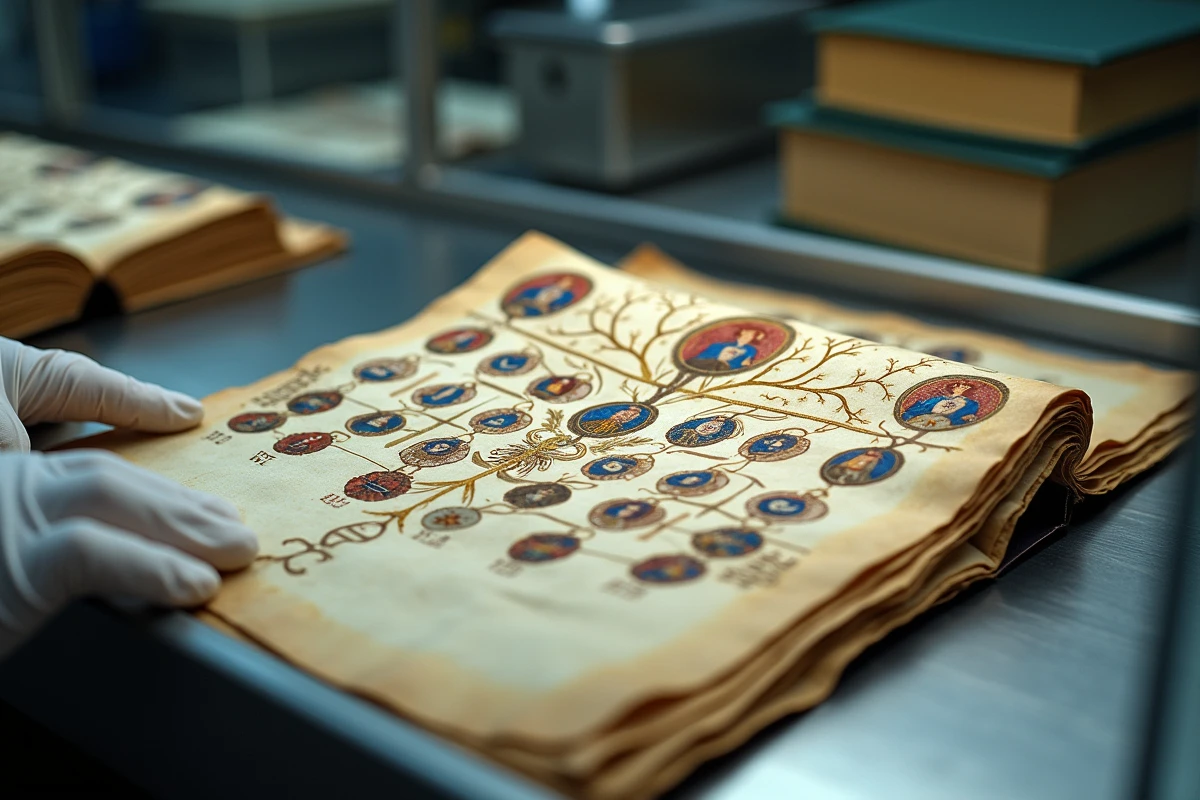
Merovingians and Carolingians: the blurred roots of the French monarchy
The further back in time you go, the scarcer the sources become. For the Merovingians, lineages often rely on chronicles written decades after the events. Gregory of Tours remains the main source for this period, but his account mixes hagiography and politics. Distinguishing the dynastic fact from the narrative construction is sometimes a challenge.
The Carolingians pose a different problem. Charlemagne is well documented, but his descendants quickly fragment among Frankish, Lotharingian, and Germanic kingdoms. The family tree of the kings of France retains only one of these branches, the one leading to the crown of West Francia. The others disappear from the national narrative, even though they carried the same Carolingian blood.
A family tree of the kings of France ultimately functions like a road map: it shows the main route and erases the detours. The dynastic breaks, the excluded claimants, the legal reinterpretations, all of this constitutes the raw material of monarchical history. Keeping this framework in mind changes the way we look at these diagrams, whether they are hung on a wall or viewed on a screen.