
You’ve just spotted a used mobile home in an ad, but the year of manufacture remains unclear. The seller is hesitant, and the documents are incomplete. However, the answer lies beneath the structure, engraved or riveted on the chassis. Knowing how to read this chassis number allows you to accurately date a mobile home and avoid unpleasant surprises during a purchase or resale.
Identification plate and QR code: the new markers on the chassis
Before crawling under a mobile home, it’s best to know what you’re looking for. The chassis number (sometimes referred to as the VIN in English documentation) is an alphanumeric sequence unique to each unit produced. It encodes the manufacturer, model, and year of manufacture.
In recent years, French manufacturers such as IRM, Louisiane, or Rapidhome have adopted riveted plates and laser-engraved codes on the chassis. Some add a QR code that links to the manufacturer’s database. The QR code allows you to find the year even if the cold-stamped number is partially illegible.
To check the chassis number of a mobile home, you first need to locate this plate, then contact the manufacturer with the recorded code. The response usually arrives within a few days.

Where to locate the chassis number depending on the mobile home brand
The identification plate is not always in the same location. Its position depends on the manufacturer and the generation of the model.
- Tongue bar (or towing bar): this is the most common location. The plate is fixed on the front part of the chassis, which was used for transport. Trigano, O’Hara, and most French brands prefer this area.
- Under the leveling plate: on some older models, the number is stamped directly into the metal, under the floor, near a leveling point. Sometimes you need to remove the skirt or cladding to access it.
- Inner face of a beam: a few manufacturers (notably Louisiane on certain ranges) place the plate on a side beam, visible by sliding under the mobile home on the passenger side.
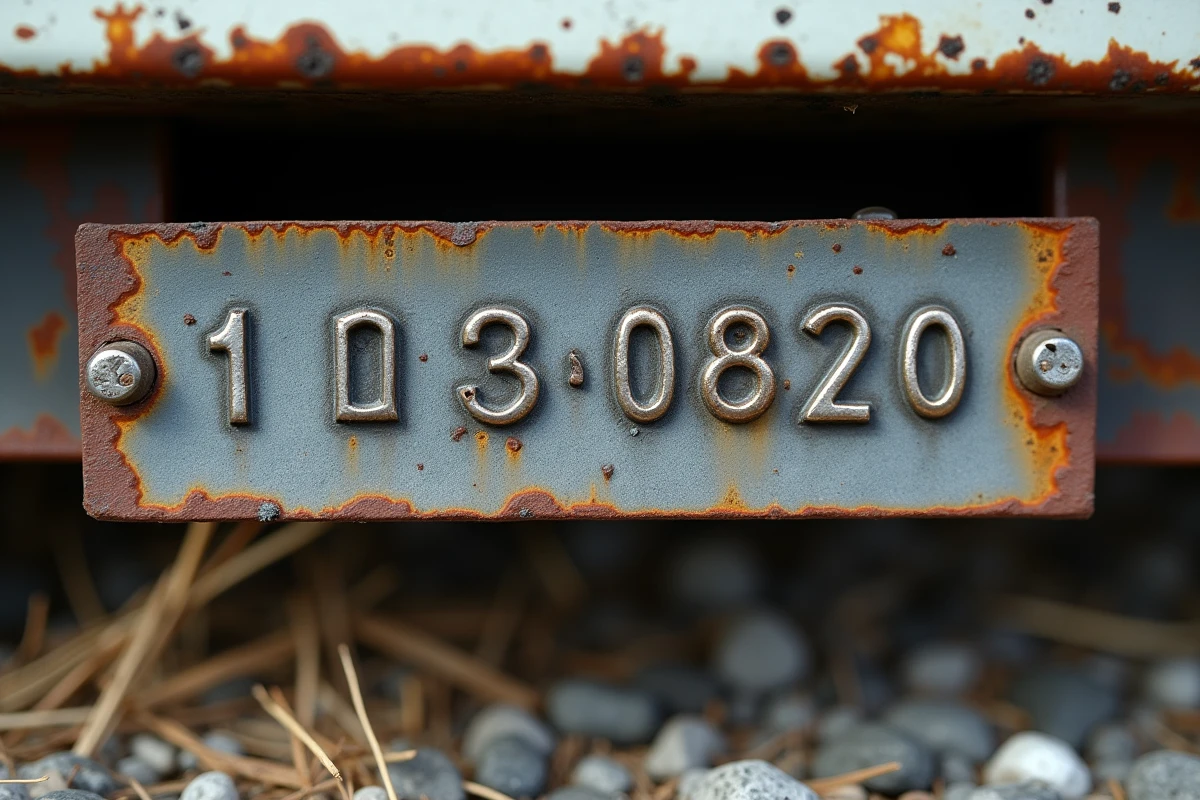
Bring a flashlight and a camera. Photographing the plate avoids transcription errors, especially when corrosion has begun to attack the characters.
Decoding the chassis number to find the year of manufacture
The recorded number does not always clearly indicate the year. On newer models, a letter or a group of digits in the sequence corresponds to the vintage. On older models, only the manufacturer can make the correspondence.
What the number contains
A mobile home chassis number generally includes a manufacturer prefix (two or three letters), a model code, a year indicator, and a serial number. For example, a prefix “IRM” followed by alphanumeric characters allows IRM’s after-sales service to retrieve the complete production sheet.
Without contacting the manufacturer, the number alone is not always sufficient to date the mobile home. Manufacturers do not use a unified format. Each brand has its own coding system.
The concrete steps
Record the complete number, then call or write to the manufacturer’s customer service. Specify that you wish to know the year of manufacture and the exact model. Keep your photo handy: you may sometimes be asked to send it to confirm the reading.
If the plate has disappeared (torn off during a move, corroded to the point of being illegible), the manufacturer can sometimes retrieve the information via the serial number listed on the sales documents or the NF conformity certificate.
Used mobile home: why the year makes a difference when buying
You might wonder why so much effort for a simple date. The year of manufacture affects the value, compliance, and acceptance in campgrounds.
Most campgrounds refuse mobile homes older than about twenty years. A model presented as recent but whose chassis reveals a much earlier vintage will pose a problem when signing the site contract.
Since 2023, expertise networks like Socotec and Dekra have integrated the verification of the chassis number into their control grids for leisure housing. An inconsistent number with the documents can lead to a reservation in the expertise report, which blocks or increases the cost of the transaction.
Galvanized chassis or not: a complementary clue
Hot-dip galvanized chassis became the norm in the French market starting in the 2010s. If you inspect a mobile home with a chassis showing marked corrosion without visible galvanized treatment, it is likely that it dates from before this period. This is not formal proof, but a clue that complements the reading of the number.
What to do when the chassis number is missing
Plate torn off, repainted chassis, erased characters: this situation is not uncommon for mobile homes that have changed owners multiple times.
- Check the original documents: the NF conformity certificate or the invoice from the first purchase almost always mentions the chassis number and the year.
- Contact the campground where the mobile home is installed: the manager often keeps a copy of the certificate in the site file.
- Ask the manufacturer for a search by model and characteristics (dimensions, number of rooms, facade color) if you at least know the brand.
A seller unable to provide the chassis number or the year of manufacture should raise caution. The absence of this information makes compliance verification impossible and exposes the buyer to a refusal of installation on the plot.
The chassis number remains the most reliable way to date a mobile home. Even if partially erased, it leaves a trace that can be exploited by the manufacturer. Taking ten minutes to photograph it before signing anything can prevent months of complications.