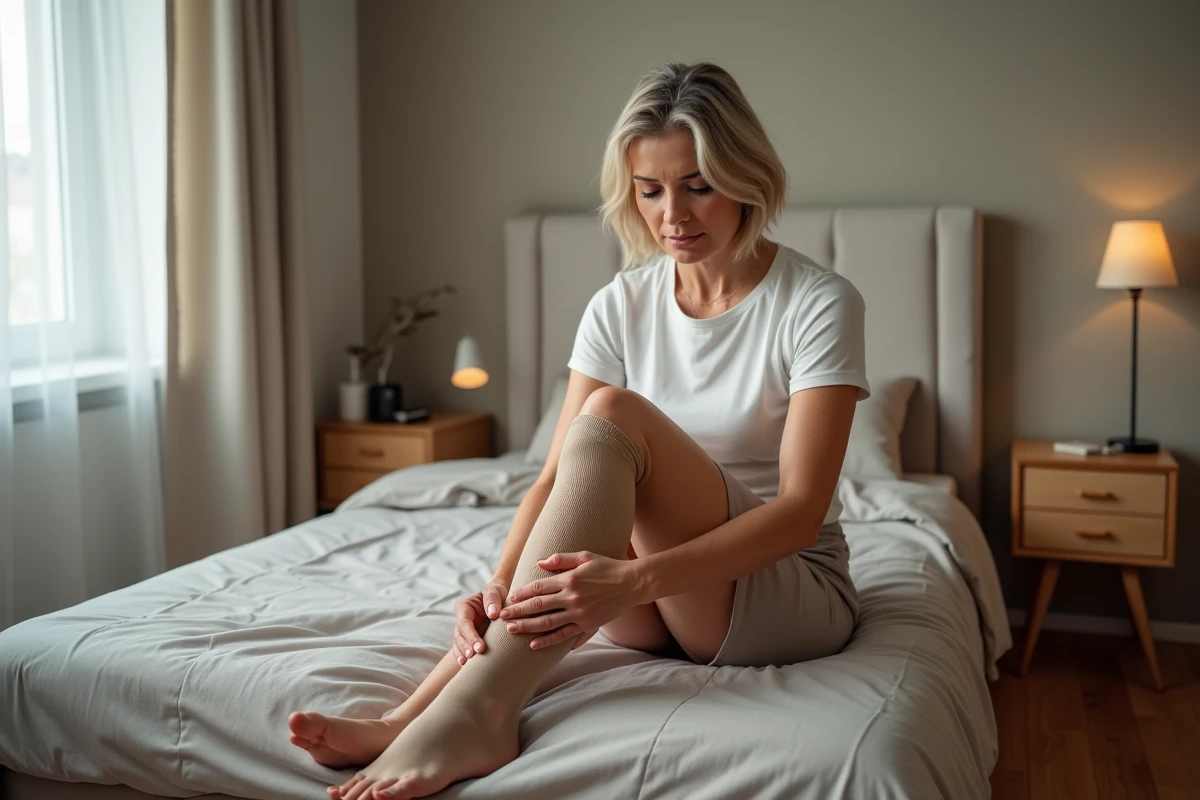
Compression stockings exert a decreasing pressure on the leg to promote venous return. When they slip, this pressure becomes disorganized, the fabric forms folds, and the therapeutic benefit decreases. Slipping is not a manufacturing defect in the vast majority of cases: it is a sizing, fitting, or wear issue with the adhesive band.
Silicone band and loss of adhesion: the often underestimated mechanism
On self-holding models, the hold relies almost entirely on a silicone band sewn at the top of the stocking. This band creates a sticky contact with the skin that keeps the stocking in place on the thigh.
The problem is that the silicone band deteriorates well before the compressive fabric itself. Residues from moisturizing cream, body lotion, or soap form a greasy film that reduces adhesion within the first few weeks. Sweat accelerates this phenomenon, especially in hot weather.
Feedback from orthopedic specialists confirms that the maintenance of this band has become a major limiting factor in the functional lifespan of the stocking. A stocking whose fabric remains in good condition can become unusable simply because the silicone no longer sticks. For several practical solutions to prevent slipping compression stockings, regular cleaning of this band with a bit of isopropyl alcohol on a cotton pad temporarily restores adhesion.
Measuring and choosing the size for compression stockings
A stocking that is too wide slips due to gravity. A stocking that is too tight rolls on itself, creating a tourniquet effect at the calf or thigh. In both cases, support is compromised and comfort disappears.
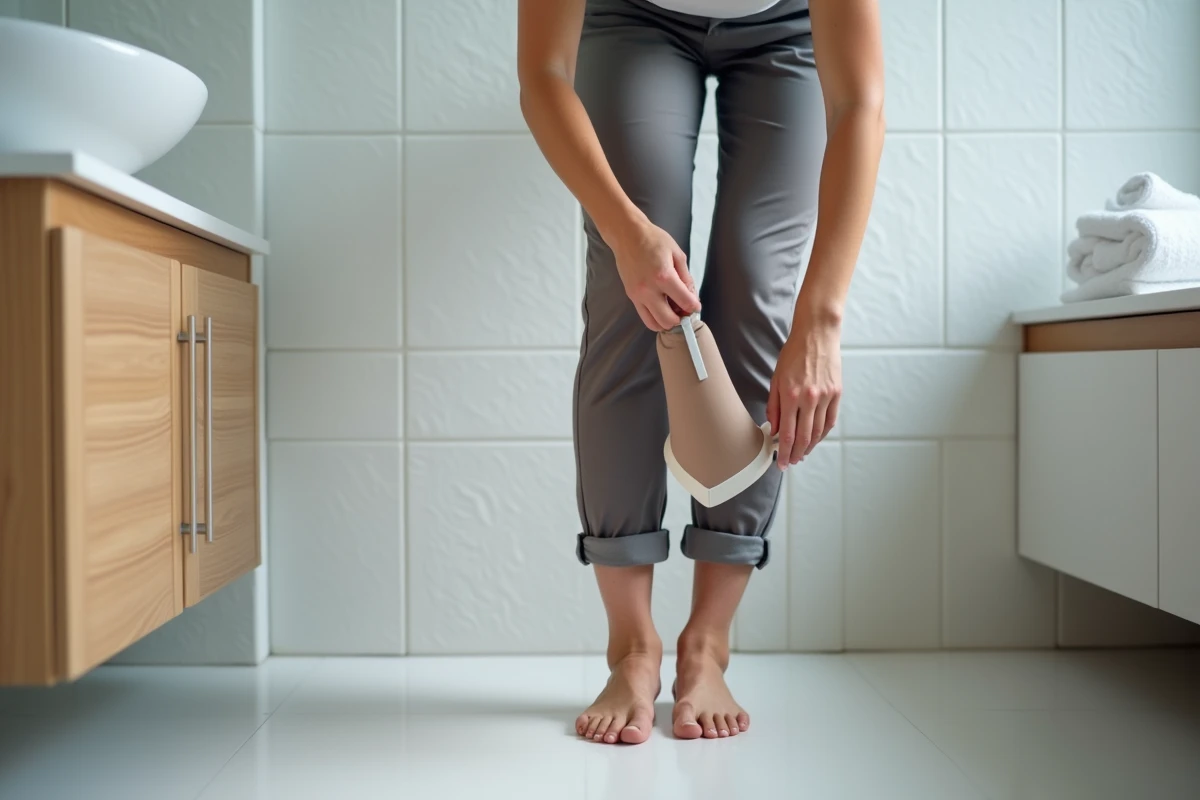
Measurements should be taken in the morning, never at the end of the day, when the legs are still slightly swollen. However, recent protocols in orthopedics recommend a window from late morning to early afternoon to obtain a representative sizing of actual daily morphology.
Four measurement points determine the proper fit:
- The circumference of the ankle at the narrowest point, just above the malleolus
- The circumference of the calf at its widest point
- The circumference of the thigh, measured approximately halfway between the knee and the groin fold
- The total length of the leg, from the floor to the desired stopping point (below the knee for socks, thigh-high for stockings)
A difference of a few centimeters in the thigh measurement is enough to switch between two sizes. Grids vary from one manufacturer to another: compare with the grid of the chosen model, not with a “usual” size.
Compression tights or self-holding stockings: the model change that resolves slipping
Content on this subject almost always focuses on “putting on better” or “washing better” the existing stockings. Orthopedic specialists have noted a marked increase in model changes to resolve chronic slipping, even among patients properly fitted with self-holding stockings.
Switching from thigh-high stockings to compression tights eliminates the problem of the silicone band. The tights hold at the waist, like a classic tight. The compromise lies in abdominal comfort, especially in prolonged sitting positions, but for those whose stockings consistently slip down, this change is often the most direct solution.
Compression socks (which stop below the knee) represent another option. They slip much less than thigh-high stockings because the holding surface is shorter and gravity plays less of a role. They are suitable when the medical prescription specifies a class 2 compression limited to the calf.
The use of garters
For those who prefer to keep self-holding stockings without a silicone band, medical garters provide mechanical support independent of skin adhesion. They attach to a belt worn at the waist and hold the top of the stocking by vertical traction. This solution is still not widely promoted, but it is particularly suitable for sensitive skin or for those who sweat a lot.

Fitting technique and daily gestures for lasting support
The fitting determines the hold throughout the day. Putting on a compression stocking on perfectly dry and non-creamed skin is the basic condition. Any application of moisturizing cream should be done the night before, not in the morning.
The method of putting on itself matters: turn the stocking inside out to the heel, position the foot, then gradually unroll upwards without pulling on the fabric. Pulling suddenly creates areas of overstretching that deform the mesh and cause rolling during the day.
Some habits extend the hold:
- Wash the stockings after each day of wear, by hand or in a machine at 30 degrees in a mesh bag, without fabric softener (fabric softener leaves a film on the silicone)
- Alternate two pairs to allow the elastane time to regain its tension between uses
- Replace stockings as soon as perceived pressure decreases, even if the fabric appears visually intact
Patients whose stockings roll or slip recurrently are more likely to abandon compression treatment in the first few months. This link between poor adhesion and non-compliance with treatment is documented in phlebology. Resolving slipping is not a detail of comfort: it is preserving the effectiveness of a medical device prescribed for a specific reason.